IT Paradigm Shift: How Risk Management Decides the Success of Your Software Development
Four major paradigm shifts have transformed IT over the past decades and yet the success rate of software projects vaires widely between companies, projects and industries. That is not because Agile development, microservices, cloud, or AI engineering don't work. It is because every one of these IT paradigm shifts primarily affects the relationship between the probability of unexpected events and their impact.
This shift is neither automatically positive nor negative. Whether it lowers or raises risk depends on how well it fits the company's context. Anyone who fails to understand this pattern unintentionally raises risk, no matter which method they choose. This is the reason so many software projects struggle with new methodologies. Instead of using the right risk management tool for their context, they try the latest and greatest IT paradigm that never lives up to expectations.
Innovation Mode vs. Operational Mode — Two Sides of the Same Coin
To place the paradigm shifts in the right context, a simplified model with two modes helps: the innovation mode and the operational mode. Like every model, it does not capture reality completely; companies often operate in both modes simultaneously, depending on product and team. But as a thinking tool, it makes the risk shift tangible.
The Innovation Mode: More Uncertainty, mitigated by lower Impact
In innovation mode, companies attempt to increase their exposure to opportunities by increasing the probability that unexpected events occur. This mode of working increases the likelihood of both positive and negative events, so to counteract this companies reduce the impact such events can have on the business. Startups and scaleups typically operate in this mode: they deliberately accept more uncertainty because the consequences of individual wrong decisions remain manageable. This is the famouse "move fast and break things" approach, and it only works when breaking things does not break your company.
Used correctly, this mode maximises learning speed and lowers the cost of individual failures. Whether overall risk actually decreases depends on the execution, not on the mode alone.
The Operational Mode: Higher Impact, mitigated by less uncertainty
In operational mode, the relationship is reversed: the impact of unexpected events is significant and therefore companies address risk by minimising the occurance of these events. Enterprises prefer this mode because it offers stability and predictability — the foundation for efficiency optimisation. We sometimes call these companies risk-averse, but this is not always true - when a simple unexpected event can ripple accross thousands of employees and disrupt carefully balanced supply chains, companies need to act. Having complex, just-in-time supply chains is in itself a form of risk-taking, and this is exactly where enterprises show their risk tolerance.
In safety-critical domains such as aviation or medical technology, this model is not enough. There, dedicated regulatory frameworks apply that go beyond a simple probability-impact trade-off.
When the Wrong Mode Becomes Chaos Mode
The problem arises when companies choose the wrong mode or implement a mode incorrectly. Agile methods only lower the impact of changes when the organisation creates the structural conditions for it: small autonomous teams, continuous integration, incremental releases. When the organisation forces teams to release their software once a year, or when planning is completely disregarded in favour of "agility", can lead to chaotic changes that derail software projects.
Without careful consideration of the operating mode, the change frequency increases without the impact per change going down. The result is a chaos mode in which events occur frequently *and* have severe consequences. This mismatch between operating mode and organisational structure is something we see regularly and it is almost always the real cause behind failed transformations.
Four IT Paradigm Shifts and Their Risk Profile
IT has experienced numerous paradigm shifts. This post focuses on four major shifts that each affect a different layer of software development: methodology (Agile), architecture (microservices), infrastructure (cloud), and execution (AI). Together they make up the full stack in which risk decisions are made. The following tables are intentionally simplified and show the tendency of each shift.
From Waterfall to Agile Development
| Probability | Impact | Condition for Success | |
|---|---|---|---|
| Waterfall | Changes not planned for – low by design | Changes invalidate entire project phases – very high | Stable, fully known requirements |
| Agile | Changes are expected – high | Change costs equivalent to normal development – low | Capacity for unplanned changes, clear quality gates |
Waterfall plans for stability. That does not mean surprises do not happen, it means they are not planned for. Agile development reduces the impact of unexpected changes through short feedback loops and iterative adjustments. But without defined quality gates, the increased change frequency can overwhelm teams that depend on predictability.
We recommend: combine agile cycles with clear quality gates (for example mandatory design documents before sprint start) and explicitly plan capacity for unplanned changes.
From Monolith to Microservices Architecture
| Probability | Impact | Condition for Success | |
|---|---|---|---|
| Monolith | Concentrated complexity, few interfaces – low | Large blast radius, resource bottlenecks – high | Disciplined modularisation within the monolith |
| Microservices | Distributed complexity, many interfaces – high | Small blast radius, service degradation – low | True service independence, platform team, defined APIs |
Microservices architecture limits the impact of individual failures to a small area. The price: complexity does not disappear, it spreads, and without corresponding engineering quality, it quickly becomes uncontrollable.
In our experience: start with a modular monolith and only introduce microservices where true independence is needed. Introducing an internal platform that systematically manages this complexity is one of the most effective levers here.
From On-Premises to Cloud
| Probability | Impact | Condition for Success | |
|---|---|---|---|
| On-Prem | Controlled environment, full control – low | Limited scaling, little practice with outages – high | Investment in self-service provisioning and software-defined networking |
| Cloud | Many independent failure sources aggregate – high | Professional incident management, SLAs – low per service | FinOps, governance, in-house cloud expertise |
Cloud infrastructures reduce the impact of individual outages through redundant systems and professional monitoring. At the same time, the overall probability of disruptions rises, because many independent failure sources (teams, services, configurations, large hardware fleets,...) interact. On top of that comes a concentration risk: when providers fail, many companies are affected simultaneously.
We recommend: use cloud deliberately for experimentation, overflow capacity, and specialised workloads instead of using it for everything. How to find the right balance between on-prem and cloud is something we explore in our Cloud Workshops.
From Manual Development to AI Engineering
| Probability | Impact | Condition for Success | |
|---|---|---|---|
| Engineers | Domain knowledge reduces errors – low | Wasted engineering time is expensive – high | Investment in training, onboarding, knowledge management |
| AI | Fast iteration, higher error rate – high | Regenerating code is cheaper than manual debugging – low | Clear scoping, efficient error detection, deliberate code-quality decisions |
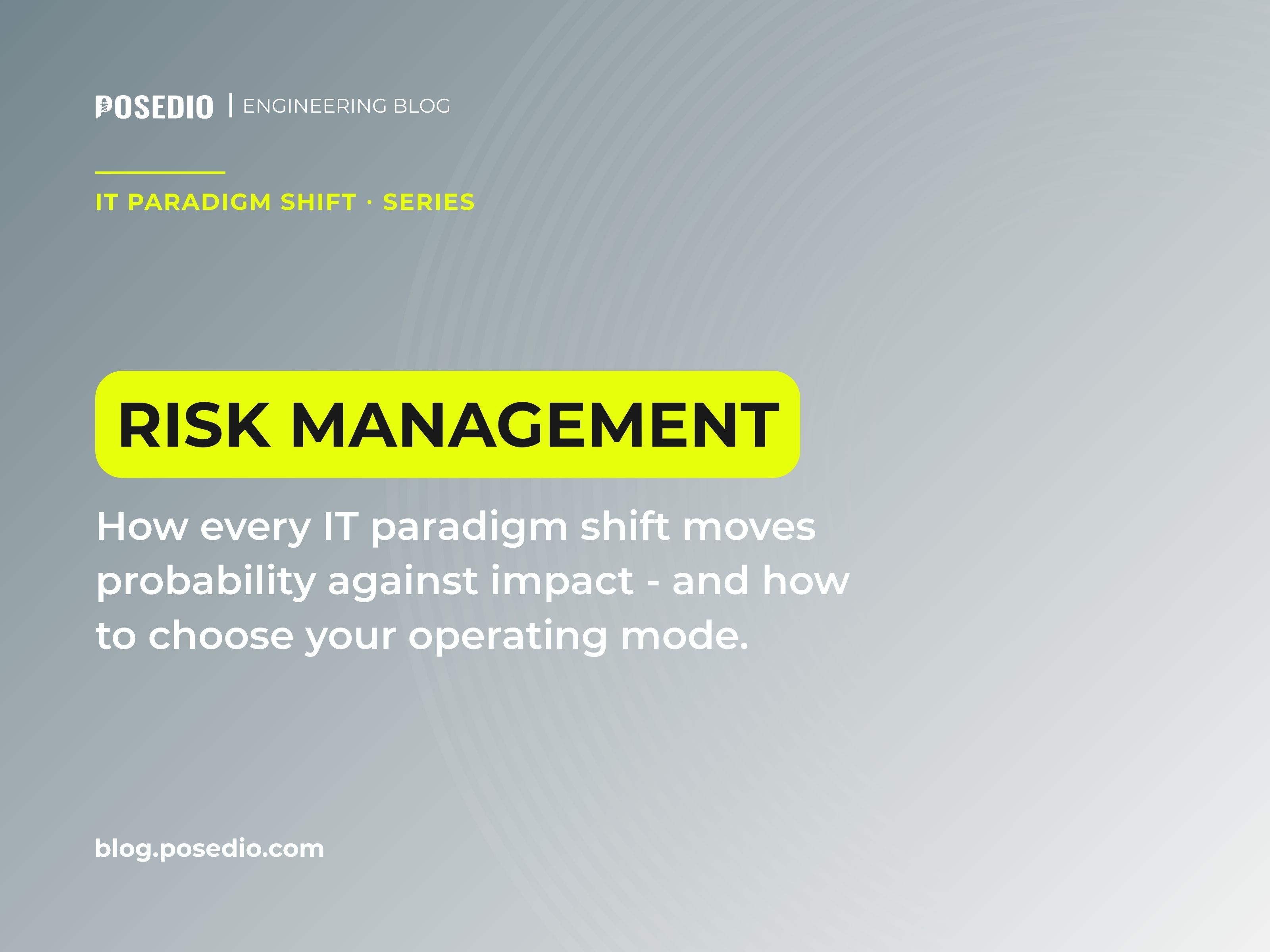
Both humans and AI produce errors but how we approach these errors can be completely different. Experienced engineers minimise the probability of errors through expertise, but their time is expensive. AI-supported development relies on rapid iteration at lower cost per attempt. Quality assurance shifts from error prevention towards efficient error detection, a fundamental change in engineering quality. The goal is to find a reliable way to signal to the AI system if a change it made is correct or not, something that reiterates the importance of a good qualty gate.
We recommend: decide deliberately whether generated code is meant to be maintained long-term or has throwaway character. Without this distinction, AI engineering creates technical debt at a pace no team can manage in the long run.
Risk-based Software Engineering: Choosing the Right Paradigm
The decisive insight: every IT paradigm shift moves the balance between probability and impact. Whether overall risk goes down or up is not a property of the paradigm but a question of fit between method and context.
Risk Appetite as the Basis for Decisions
Companies that depend on predictability and stability, for example in regulated industries, do not automatically benefit from pushing all levers towards innovation mode. Conversely, startups miss opportunities when they switch to operational mode too early.
The key lies in the deliberate combination of the four levers. Risk-based software engineering means defining your company's risk appetite explicitly and aligning method, architecture, and infrastructure decisions to it deliberately. Factors such as organisational culture, scaling needs, customer needs, and existing competencies play a central role.
Engineering Quality as a Precondition for Successful IT Paradigm Shifts
It becomes especially dangerous when companies adopt paradigms because they are trendy, without understanding the impact on their risk profile. Agile development without capacity for unplanned changes leads to chaos. Microservices without a platform team produce uncontrolled complexity. Cloud without FinOps becomes a cost trap.
Engineering quality does not arise from following trends, but from the deliberate choice of the right tool for the right task, aligned with the reality of your organisation.
Conclusion
All four paradigm shifts follow a common tendency: the probability of unexpected events rises, while their impact per individual event falls. Whether overall risk goes down, stays the same, or goes up depends on the execution. The decisive thing is to choose your operating mode deliberately and to understand risk management of software development as a strategic lever, not as a by-product of technical decisions.
Looking Ahead: The Cost Perspective
In the next post in this series, we show why the same IT paradigm shift also fundamentally changes the cost structure and why the shift from CapEx to OpEx is a hidden cost trap for many companies.