Our road to ISO 9001 certification
It was October 2021 when we first heard the details about ISO 9001 from an ISO expert. Posedio had only just started operating and consisted of nine people back then. Our motivation was high, our knowledge of quality management and what it requires still modest.
We quickly realised the certification could give us structure and help us build the company. We were also clear that if we were going to do it, we wanted to do it properly, not just to get a certificate on the wall as fast as possible. What we did not know yet: it would take considerably longer than we thought.
Building structure
At the start it was mostly basic questions. Which processes do we need? How do we define responsibilities? Who takes on the role of process owner? And how do we build a quality management system that works not just in theory but actually helps us and our clients in their daily work?
At the same time we had to build a company more or less from scratch. New, unplanned tasks kept coming up, client projects had to be prioritised and deadlines met. That applied to our ISO project too, which got pushed back more than once.
Meanwhile Posedio kept growing. Our headcount has nearly tripled since the early days, responsibilities have shifted and our organisation has become more complex. With that, the demands on our internal workflows and processes grew too.
Throughout, the support of our ISO expert was especially valuable. With an experienced outside view he kept asking the right questions, including the critical ones, and challenged us.
Bringing the team along
From the start it mattered to us to involve our people in this process and make clear why quality management is worthwhile for us as a company.
Introducing processes and extra structure did not always meet with enthusiasm right away, especially in a young and fairly small company, to be honest about it. A lot worked fine through quick, direct coordination, so the question came up whether extra processes were really necessary.
But the more our people engaged with it, the clearer the benefits became. For a small, growing company in particular, it helps to bring some structure into the organisation, define responsibilities clearly and make workflows easy to follow.
So we started early to build quality management actively into our everyday work. This includes, among other things:
- •Regular management reviews: we review our goals, processes and the ongoing development of our quality management system.
- •Town hall meetings: we keep the team updated on current developments, key decisions and the direction of the company.
- •Defined processes and responsibilities: our core business areas have clear workflows and assigned process owners.
- •Change management: changes to the quality management system are planned, assessed for risks and opportunities, implemented, rolled out with training, and then checked for effectiveness through audits.
- •Internal training: the introduction to the quality management system and the training for it are core parts of onboarding from day one, followed by regular training.
- •Continuous improvement: there is an annual employee and client survey, a debrief at the end of every project, and regular professional development.
Today our quality management system covers eight core processes: Quality Management, Management, Finance, Sales, Marketing, HR & Administration, Technology and Internal IT.
The external audit
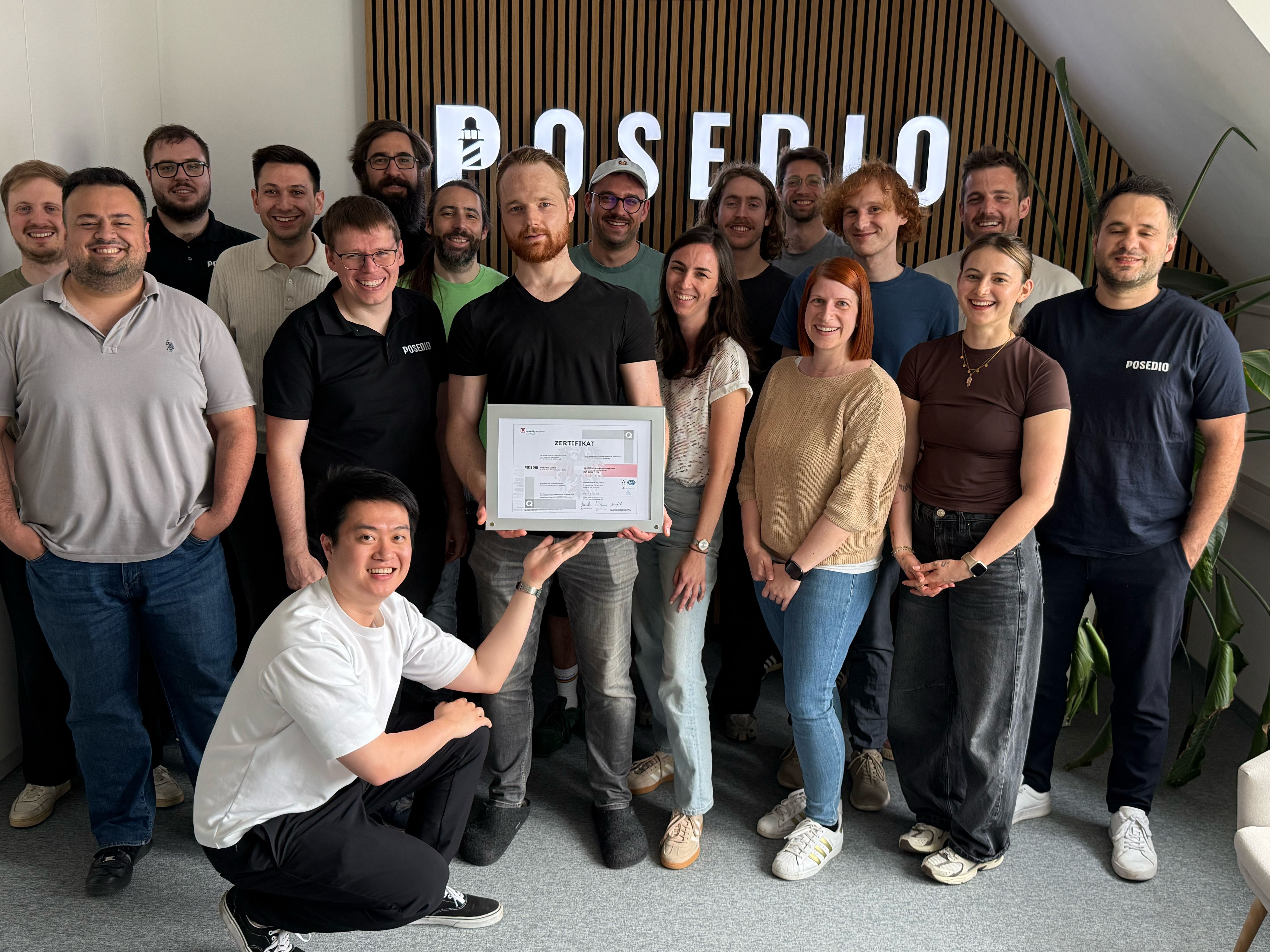
In early 2026 the time had come: we passed the external audit and had the use and ongoing development of an effective quality management system confirmed in line with the requirements of ISO 9001:2015.
With that we wrapped up a longer development process. We are especially glad that the processes we built are now a fixed part of our working day. They were not just documented for the certification, they are genuinely part of how we work day to day.
Looking back, getting there was an important part of how the company developed. We learned to shape workflows more deliberately, define responsibilities more clearly and develop our organisation with future growth in mind.
What's next
After the certification is before the certification, because on information security we are taking the next step as well: we are already working on an information security management system (ISMS) to ISO/IEC 27001. As we grow, so does the responsibility to build information security systematically into the company. Rising demand from our clients and new requirements from regulations like NIS2 and the Cyber Resilience Act (CRA) reinforce this.
Our goal is to complete this step about a year after the ISO 9001 certification, so in the first quarter of 2027. Whether we manage it as planned remains to be seen. We will report back either way!